 |
CATHOLIC CHURCH OF OUR LADY & ST PETER, LEATHERHEAD THE SPIRIT OF CATHOLICISM: CONTEMPLATION & COMPASSION, COURTESY &
COURAGE Through Christ in the Spirit to the Father (Eph. 2:18) 'Act justly, love mercy, walk humbly with your God'. Micah 6:8 Ever seeking a Grace-filled culture of love. |
 |
A HISTORY OF OUR PARISH & ITS CHURCH
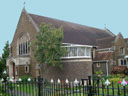
Most of the material for the sections from 1914 to 1946 is based upon the booklet researched and written in 1995 by the late Bernard Moulson (Requiéscat in pace). The web-master, however, takes responsibility for all the content of this page. He has endeavoured to be accurate but welcomes more detailed information and suggestions.
All the pictures on this page are from our Parish Church of Our Lady & St Peter.
Introduction: before the Reformation
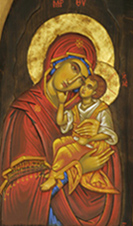
O Blessed Virgin Mary,
Mother of God,
look down in mercy upon
England, your dowry.
We have no record of when Catholic Christianity came to Leatherhead (or Leodridan as it was called in the Old English language of the 9th century). But it must have come early, as 10th century records refer to an 'old minster'. Such minsters were collegiate churches founded in the early days of Christianity to support a team of priests serving a large territory. But in time individual parishes emerged and the 10th & 11th centuries saw the founding of many local parish churches. One such was built by the Lords of Thorncroft manor and became the parish church for Leatherhead; the old minister seems to have fallen into dissuetude.
The new parish church was on the site of the present Anglican church and, indeed, parts of the present Anglican church date back to the late 11th or early 12th centtury. Here the Mass was celebrated for four centuries or so, until in the 1530s Henry VIII broke with Rome and dissolved Leeds Priory, in Kent, which had been appointing Leatherhead's parish priests since the mid 14th century. For a few years Catholic worship was restored under Mary I, but this ceased under the Protestant government of Elizabeth I and, as far as we can tell, regular Catholic worship did not return to Leatherhead until Advent, 1914.
1914 - 1915: The Mass is restored to Leatherhead
Although Our Lady & St. Peter's Church was not built until 1923, our parish's immediate history may be reckoned to have begun some nine years before at the beginning of the First World War.
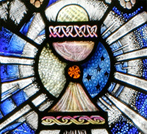
Sweet Sacrament Divine,
Earth's Light and jubilee,
In thy far depths doth shine
Thy Godhead's majesty.
From Advent 1914 until October 1915 Mass was said each week for the Catholics of Leatherhead and the surrounding area by Father Lippens, a Belgian priest of the Congo Mission Fathers. Fr Lippens was acting as chaplain to the military hospital which had been established in the Red House (on the site of the present office block known as Fairmount House) at the top of Bull Hill.
Occasionally, the Sunday Mass was said by Father Haffenden from Effingham, where a church had been built in the 1890s. About fifty people would attend these Sunday Masses. It is believed that this was the first time Mass had regularly been celebrated publicly in Leatherhead since the time of the Reformation.
Before 1914 Catholics from the Leatherhead area had to make their way at least to Epsom, Effingham or Dorking if they were to hear Mass. One Leatherhead parishioner recalled in the 1980s how as a girl she would walk with her family to and from Epsom on Sunday mornings except when, occasionally, a local farmer going their way with his horse and cart gave them a lift.
1915 - 1917: Father Bernard Kelly - a zealous missionary for St Peter
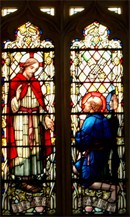
"You are Peter"
The first steps towards the re-establishment of Catholic life in Leatherhead were taken in 1915 with the setting up of a mission under the patronage of St Peter. The priest in charge was Father Bernard Kelly.
When Fr Kelly took charge of the mission in October, he lodged in a house in The Crescent at No. 4. It is still there still next to the opening into Church Walk.
The sparse records that remain of Fr Kelly's early days in Leatherhead suggest that he was a man of single-minded devotion to his work as a Catholic missionary to the area, and of remarkable energy. On his first Sunday in the town he said Mass at the Red House and by the following Sunday he was also holding a catechism class for six children at his lodging.
Although Fr Kelly's principle and all-important roles were to offer Mass and to teach the Catholic faith, these had to be coupled with tackling the largely material problems in the way of establishing and organizing a centre of Catholic life in Leatherhead and thus laying the foundations for what would in due time be a Catholic parish.
In a strange town, and with no organized support, the priest might well have decided on a strategy of "hastening slowly". Fr Kelly did not. During that first hectic week he became the tenant of a house in Linden Gardens and had persuaded the owner to allow two downstairs rooms to be made into one to serve as a chapel. The following day Fr Kelly arranged with a local carpenter for a temporary wooden altar to be made. The house was known then as 'Editha'.
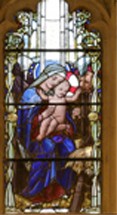
The Word was made flesh.
On 6th November 1915 Fr Kelly moved into Editha, which, besides housing the chapel until 1923, was to remain the priest's house until 1926. The next day, Sunday, he said Mass there for the first time.
It is recorded that on the very next day workmen came and began the work of making the two rooms into one for the chapel. It took about four weeks as, owing to war-time scarcity, there was some difficulty in obtaining the girder.
On Christmas Day 1915, three Masses were said in the new chapel. Father Kelly remained in charge of St Peter's
mission for a little over two more years until, at the very beginning of 1918, he was succeeded by Fr Francis Redaway.
1918 - 1922: Father Francis Redaway & the Hulton connection
Fr Redaway was remembered principally as a man of holiness and poverty. It was during his time that local Catholics began to consider the possibility of building a church; and also that Sir Edward Hulton became interested in the project. Indeed, it is possible that without his interest, the church we have now would not have existed.
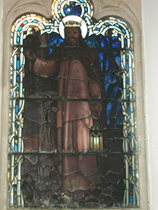
"I stand at the door and nock."
Sir Edward, who lived at Downside in Leatherhead, was not a Catholic but his wife was. He was a successful newspaper proprietor, but his health was not good at this time and he was shortly to sell his many papers. Sir Edward came to know the mission financially, particularly during 1921 when Fr Redaway became seriously ill.
Before Fr Redaway had to retire for health reasons in January 1922, Sir Edward had let him know that if the Building Fund Committee and the Catholic diocese of Southwark were able to meet certain financial targets he would guarantee the major part of the cost of a new church. Under the chairmanship of Fr Redaway's successor, Fr Reginald Pitts, the Committee was able to ensure that these conditions would be met. In the event, Sir Edward did all he promised, and much more as well.
1922 - 1923: The church is built
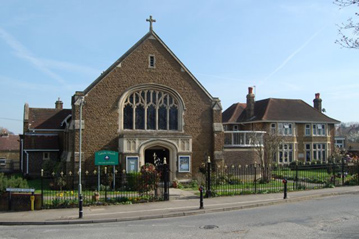
Land in Garlands Road was bought in July 1922, designs were drawn up with the very active involvement of Sir Edward Hulton and approved by the diocesan authorities. In the same month work began on digging the foundations for the new church. The first brick was laid on 28th August.
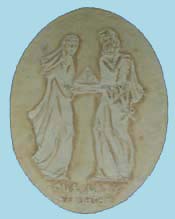
Our Lady, pray for us.
St Peter, pray for us.
The work was well advanced before a disagreement between the Bishop and Sir Edward, over the dedication of the church, was finally resolved. Sir Edward had expressed the wish that it should be known as St Mary's, in memory of his late sister; the Bishop wished it to continue to be dedicated to St Peter, as was the mission of which it would still be part. Eventually a compromise was reached: both the church and the mission (for Leatherhead was not yet a Catholic parish) would be dedicated to Our Lady and St Peter.
The main structure of the church was completed by June 1923, so that it could be blessed, and the first Mass said, by Father Pitts, on Sunday 24th June, the feast of the Birth of St John the Baptist.
In September 1923, a few months after the opening of the new church which he had never seen, Fr Francis Redaway died. On 3rd October his body was brought to Our Lady & St. Peter's to rest overnight, and the next day Requiem Mass was said before his burial in Kensal Green: Requiescat in pace. The congregation included the Bishop and about thirty other priests.
1923 - 1925: " Sir Edward's" church
The exterior of the church is mainly of Bargate stone from Godalming; the stonework inside is in Bath stone. One of the glories of the church is its windows, and none is more striking than that of the east end. Its three sections depict, from right to left:
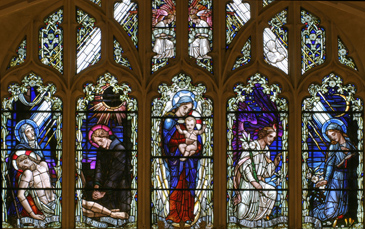 |
In two small centre lights at the very top are two angels holding banners with the words "Jesu mercy, Mary help". |
This magnificent window, which holds the attention as one enters the church, is like most of the windows in the church, the work of Paul Woodroffe, a Gloucestershire artist who had clearly been much influenced by the Pre-Raphaelites. It was commissioned by Sir Edward Hulton as a memorial to his parents and sister and bears the inscription "In loving memory of Edward Hulton, his wife Mary, and their daughter Mary Ellen. May they rest in peace."
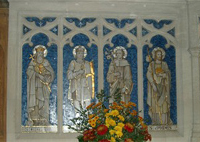 |
Beneath the window is the Reredos (a feature of Catholic churches since 7th Century) with figures of eight saints set against a blue mosaic background, four each side of the tabernacle. These figures are four men and four women who are all of the patron saints of members of Sir Edward's family. His wife would have been included only there was no St Millicent in the Church's calendar. |
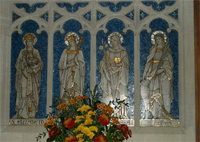 |
Below is the entry for 24th October 1923 in the order books of James Powell of Whitefriars. It records that design cartoons were by Miller and that the figures, in opus sectile, cost £320 which, at that time, was a considerable amount of money. It will be noticed that the church is referred to as St. Mary's; clearly the order was placed before Sir Edward Hulton's wishes about the name had been vetoed by the bishop and the compromise dedication of Our Lady & St Peter had been adopted.
882. p.297 24/10/23 St Mary, Leatherhead Reredos panel, opus
St Edward, George, Anthony, James, Elizabeth, Margaret, Theresa, Agnes. Ctns Miller £320
The order books are now owned by the Victoria & Ablert Museum and have been transcribed by the Tiles & Architectural Ceramics Society. You may download their transcription by clicking here.
Below the reredos the altar was set close to the east wall. It is, however, no longer there, nor are the altar rails which once separated the sanctuary from the nave. These were removed to accommodate the liturgical changes that came after the Second Vatican Council and a new free-standing altar was erected in the centre of the sanctuary (an Altar Frontal was added in 2005 and is described below).
The light coloured timber panelling in the sanctuary is of Japanese oak. On the south side of the sanctuary the window is clearly derived from the Holman Hunt painting, Light of the World (a photograph of this window appears earlier on this page).
Around the walls, starting on the north side by the Lady Chapel, are the fourteen Stations of the Cross,
designed by Eric Gill. Shortly after the church was substantially completed, in 1923, Sir Edward Hulton
sought advice about an artist who might produce a set of Stations.
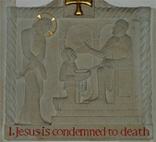
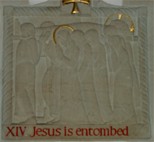 Gill's name was mentioned and Sir Edward went to see the large Stations of the Cross which Gill had completed
only a few years earlier in Westminster Cathedral. He then met Gill, and the work we now have was commissioned.
Until the 1980s there was at least one parishoner who could remember seeing the "strangely dressed man" [Gill]
perched on the steps doing the final work on the Stations as they were fixed in groups of two or three after being cut
in Gill's studio near Ditchling in East Sussex.
Gill's name was mentioned and Sir Edward went to see the large Stations of the Cross which Gill had completed
only a few years earlier in Westminster Cathedral. He then met Gill, and the work we now have was commissioned.
Until the 1980s there was at least one parishoner who could remember seeing the "strangely dressed man" [Gill]
perched on the steps doing the final work on the Stations as they were fixed in groups of two or three after being cut
in Gill's studio near Ditchling in East Sussex.
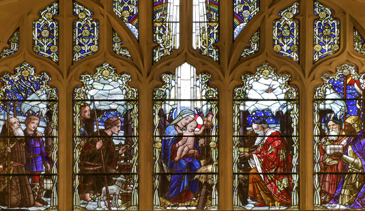
In 1924, while the Gill Stations of the Cross were being completed, another of the glories bequeathed to us by Sir Edward Hulton was erected. This was Woodroffe's West window with scenes from the Christmas story. Unfortunately, this wonderful window is obscured from much of the church by the loft, added long after the window was erected. But if one stands just below the sanctuary, particularly in the late afternoon light and looks back, one can see exciting blaze of colour with which Woodroffe depicted the scenes.
The last of the Gill Stations of the Cross were finished in April 1925. The following month Sir Edward Hulton died, on 23rd May. The next day his body was brought to the gates of "his church" for a short service of blessing on its way to London (Requiescat in pace).
1926 - 1928: In Memoriam - a presbytery & a chapel
In 1926 Lady Hulton had let it be known that she and members of the Hulton family would pay for the building of a presbytery next to the church as their own memorial to Sir Edward. A week before the end of that year Fr Pitts was able to move into the new building, thus cutting the last link with 'Editha' in Linden Gardens which eleven years earlier has caused Catholics on Leatherhead to rejoice that they now had both a priest, the redoubtable F. Kelly, and their own chapel.
One of the windows in the south wall of the church shows our Lord giving St Peter charge of his Church. It
carries the inscription "Pray for the soul of Sir Edward Hulton - mindful of his many generous gifts.
R.I.P." The window is by Paul Woodroffe and was commissioned by members of the congregation for
the chapel of the Sacred Heart which is on the right of the church below the sanctuary.
(A photograph of this window
is shown above in the Section about Fr Bernard Kelly)
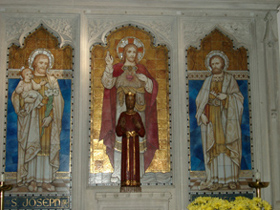
This chapel, with its reredos of opus sectile panels depicting the Sacred Heart of Jesus, St. Joseph and St. Peter, and the St. Peter window, were paid for by public subscription as the congregation's own memorial of Sir Edward Hulton.These works date from 1928.
Below is the entry in order books of James Powell of Whitefriars for 12th January 1928. We see that the panels
for the reredos cost £120 and that the design cartoons were by Reid. It will be noticed that the church is
referred to simply as "RC church, Leatherhead."
915. p.96 12/1/28 RC church, Leatherhead
3 panels opus, Reredos. Joseph & child, Christ, Peter (Ctns Read) £130.
Later a way had to be made through the south wall of the chapel and the window was put where it is now, in the south wall of the nave. The two lights of the window next to it are also by Woodroffe. Both are dedicated to Our Lady. One, which had been ordered as a specimen by Sir Edward Hulton, has the emblem "Lilium inter spinas" (Lily among thorns); the other, the gift of Fr Pitts, has the emblem "Rosa mystica" (Mystical Rose). The latter dates, like the St Peter window, from 1928
Post-1928: Later additions
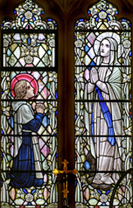
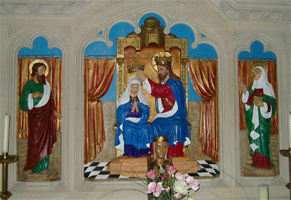
Below the chancel, on the left, is the Lady Chapel. The window recalls the apparitions of Our Lady to Marie Bernarde Soubirous (later St Bernadette) at Lourdes in 1858.
The relief above the altar portrays centrally the coronation of Our Lady in Heaven, and on either side figures of her parents, St Joachim and St Anne. This, and the window, were later additions to the church.
The Baptistry is also a later addition. The plain glass is a splendid example of exceedingly rare English plain glass - an art now lost to the country. The font is of Saxon stone carved with scenes of the life of John the Baptist. It was the work of John Skelton, nephew of Eric Gill, who, like his uncle, was a member of the Guild of Dominic.
1946: Our Parish serves two other Mass centres
By 1946 priests from Our Lady & St. Peter's, which had already been established as a parish church, were serving two Mass centres, one in Ashtead and the other in Fetcham, as well as St. Andrew's Convent. The nuns have left the area after years of great work. The offspring of Our Lady & St. Peter's in Ashtead and Fetcham are now each Catholic parishes in their own right: St Michael, Ashtead and The Holy Spirit, Fetcham, (now part of the Parish of Effingham with Fetcham).
2000 and after: I - into the new millennium
Above the Sacristry door is a panel depicting Our Lady and st Peter; a picture of this panel may be seen above in the section "1922 - 1923: The church is built". This panel was created in 2000 by the Sussex artist, Mary Cox, as a memorial to the late Bobs Lee. Requiescat in pace.
Towards the back the church on the north wall is the Millennium Window. This window comes from the studio of Caroline & Tony Benyon and was designed by the Parish Priest, Fr Michael Masterson. Caroline & Tony Benyon have incorporarted some pieces of glass from the batch of glass manufactured for Paul Woodcroffe and used by him to make the other windows in the Church seventy years before. The window consists of two lights:
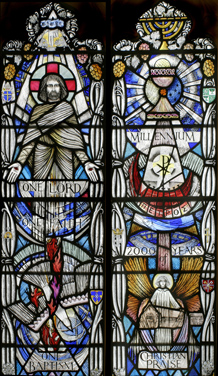
- The left-hand light depicts the Blessed Trinity with the Father's hand of blessing at the top, below which we see the risen glorified Son, and the Holy Spirit swooping down upon the creation and bestowing his seven gifts and the seven sacraments, both sets being symbolized by the seven flames.
- The right-hand light represents the Holy Catholic Church. At the top is the seven branched candlestick (the Menorah) showing our origins in Judaism & the Old Covenant, and the the Holy Eucharist representing the New Covenant in the body & blood of our Lord Jesus. Below the Holy Catholic Church is depicted by the ship, the barque of Peter, above a fish, the ancient symbol of Christ - the old Greek ICHTHYS "fish" being an acronym for Jesus Christ (Iesous CHristos), God's Son (THeou Yios), Saviour (Soter). At the bottom of the light is our own church of Our Lady and St Peter sheltered in the protective wings of "The Angel of the Church of Leatherhead."
Like the other windows in our church, the two lights are framed with the vine. Thus the window, with its lights framed like the other windows and incorparating pieces glass originally manufactured for Paul Woodroffe's, represents both continuity and change. The window was made possible through the generosity of the Richmond estate; at the bottom of the window we find the names of the late Victoria and Laurence Richmond. Requiescant in pace..
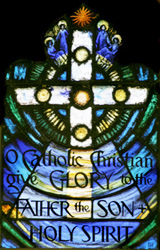
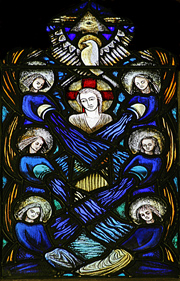
In the Sacred Heart Chapel we see another new window, the Jordan Window, which is also the work of Caroline and Tony Benyon. The window is the gift to our parish of the Ball family. It has two lights. The one on the right depicts the baptism of Christ in the River Jordan, with the Holy Spirit descending from the Father onto the Son, our Lord Jesus.
The left hand light depicts a Celtic Cross with the text: " O Catholic Church give glory to the Father, the Son and
the Holy Spirit." Thus, just like the Millennium Windown, the Jordan Window also reminds us that the God we
in Leatherhead worship & the Holy Catholic Church has worshipped down the ages is the Holy and Undivided Trinity.
2000 and after: II - additions to the Sanctuary
The painted Antependium (or Altar Frontal) is a later addition and is set into the Altar of Portland stone.
The custom of carved or painted frontals on altars, called Antependia, was already well established by the 8th Century.
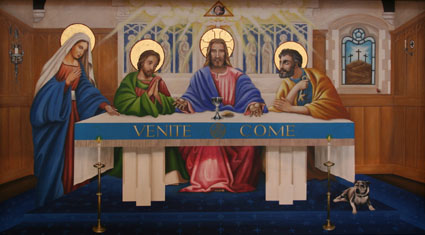 Our Antepedium was painted in 2004 by the Catholic artist Gary Bevans who painted the reproduction of the
Sistine Chapel ceiling in the Catholic Church at Goring-by-Sea.
Our Antepedium was painted in 2004 by the Catholic artist Gary Bevans who painted the reproduction of the
Sistine Chapel ceiling in the Catholic Church at Goring-by-Sea.
The Antependium depicts our Lord Jesus Christ at the Last Supper. He is flanked by St Peter and St John with Our Blessed Lady nearby. Through the window we get a view of Calvary with its subtle hint of Resurrection. This window serves to link the Last Supper with the sacrificial death of Christ as well as his glorious Resurrection from the dead: all aspects of the great mystery of the Sacrament of the Altar. Sitting below the Lord is Father Michael's dog, Bella, who was a familiar sight at the foot of our Altar for many years and who had sat at the foot of many another altar for the 15 years of her doggy life.
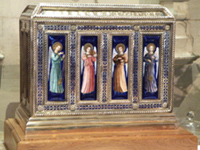
The chest-style Tabernacle was installed In 2005 on the feast of St Thomas Aquinas. It is based on Italian Renaissance models and was made in Spain by Talleres de Arte Granda. This organization was founded in 1891 by Fr Granda as a service of sacred art for the Church.
The front of the Tabernacle depicts four angels on enamelled panels; two of the angels have incense thuribles and the other two hold musical instruments. This Tabernacle was funded by a generous bequest from the late Nancy Cuffe. Requiéscat in pace.
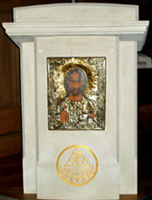
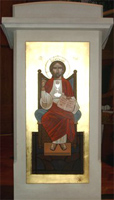
Two ambos or reading desks of Portland stone now complement the Portland stone altar. They are to the design of Christian Marshall, and each has an icon on it (more details of these icons and other icons are given in the Section below).
The ambo on the north side, from which the scriptures readings are read and the homily given, has an early 19th century icon of Christ Pantocrator; the one on the south, from which the priest reads prayers and gives announcements, has a 21st century icon of Jesus Christ, the Light of the World.
Below we see a photograph of the Sanctuary with these additions and with two large icons by Gary Bevans, one of the Resurrection and the other of the Ascension. These icons are described in the next section.
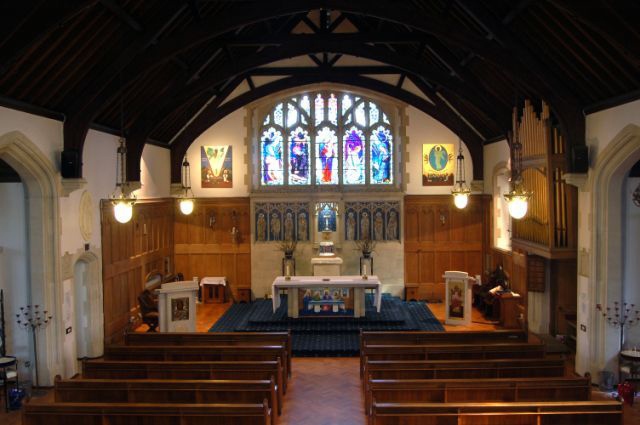
2000 and after: III - the new icons
In the Lady Chapel there has long been a copy of the famous icon of "Our Lady of Perpetual Succour" (the original is in Rome in the church of Sant'Alfonso di Liguori all'Esquilino), there were no other icons. Since the beginning of this century we have seen the addition of several icons:
Kasia Pisarek
The artist Kasia Pisarek is a Polish member of our Parish. She has presented us with the early 19th century Polish or Russian icon of Christ Pantocrator
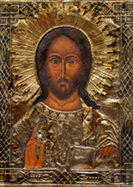 which was acquired for the Parish in Poland and is now placed on the ambo on the north side of the Sanctuary.
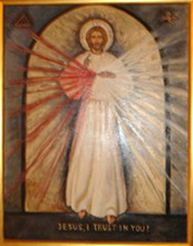
She has also painted and presented to the Parish an icon of the Divine Mercy based on the visions of St Maria Faustina in Poland. This more recent Catholic devotion to the Divine Mercy is a re-presentation of devotion to the Sacred Heart of Jesus inspired by the visions of St Margaret Mary Alacoque in France. Both these visionaries were reigniting a devotion to the real, warm, consoling love of Jesus for each of us individually - a devotion which can be traced back through the Catholic mystics of the Middle Ages to apostolic times as we see in the writings of the time of St John the Evangelist and St Paul of Tarsus. It is fitting, therefore, that this icon has been placed in the Sacred Heart Chapel in our church.
Dr Stéphane René
|
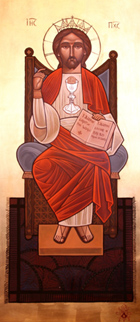
Dr Stéphane René is a London-based iconographer who works in the Neo-Coptic style and is one of very few exponents of this sacred artistic tradition in the West.
He has, since completing his PhD at the Royal College of Art, London, in 1990,
fulfilled several large commissions both in the UK and abroad, notably the
Coptic Orthodox Cathedral of the Archangel Michael, Santa Ana, California, and St Mark's Coptic Orthodox Church in London. We are fortunate in Leatherhead to have five examples of Dr René's work. 1. Forming the front panel on the ambo on the south side of the Sanctuary is icon, shown on the right, which depicts Jesus Christ, the Light of the Word and Living Bread from Heaven. Below you see two icons which are on the north wall of the Sanctuary. The two icons, which were purchased with a kind bequest in memory of Clayton Kirk who was an extraordinary minister of Holy Communion and an altar server at our church for very many years (Requiéscat in pace), are: |
 |
|
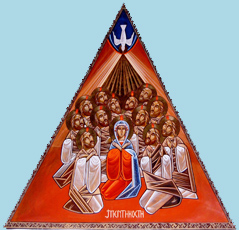
| 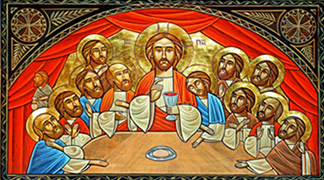 | |
| 2. The triangular icon above left depicting the descent of the Holy Spirit on Our Lady and the Apostles at Pentecost; 3. The rectangular icon above right depicting our Lord's Last Supper with his Apostles. | ||
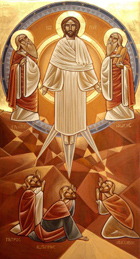 |
The two remaining icons are to be found on the front of the loft at the west end of the church. They are: 4. On the left an icon depicting the Transfiguration of Our Lord. In it appear Elijah on Our Lord's right and Moses on his left, and beneath are shown the figures of the apostles Peter, John and James. 5. On the right an icon depicting Christ's Resurrection. |
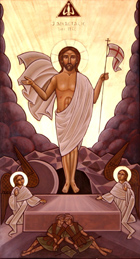 |
Gary Bevans
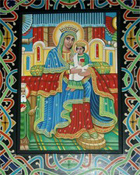
| As well as painting the Antependium (see previous section), the artist Gary Evans has painted three of our icons. 1. In the center of the balcony between the two icons by Dr Stéphane René is the icon of Our Lady with the child Jesus depicted in the Ethiopian style. It also shows St Joseph as a small figure on the left-hand edge; the proportion is theological, not physical! The other two icons are larger and are mounted on the wall at the east end of our Church on each side of the East Window. |
 | |
.jpg) |
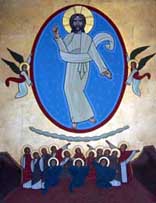
2. The icon on the left of the window depicts Our Lord's Resurrection; to right of risen Christ (our left as we look at the icon) we read in Byzantine Greek: XPICTOC ANECTH (Christ has risen) and on his left: AΛHΘOC ANECTH (Truly he has risen). 3. The icon on the right of the window depicts Christ's Ascension into Heaven with the apostles looking upwards. |
 |
2000 and after: IV - the Processional Cross
In 2014 the church received a splendid new processional cross, funded by a generous bequest from the late Mary Cuffe. Requiéscat in pace.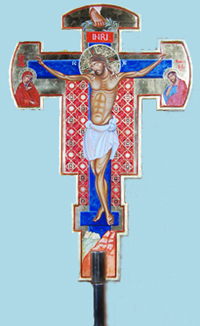 |
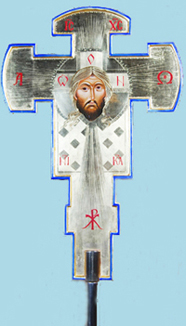
The cross has a figure of Christ painted on both faces. In the nimbus surrounding Christ's head on both faces are
written, as in all Greek icons of Our Lord, the Greek letters  "THE ONE WHO IS." "THE ONE WHO IS."This is the name given in the Greek Old Testament (Septuagint) when God speaks to Moses from the burning bush: "I am THE ONE WHO IS. You shall say to the children of Israel: THE ONE WHO IS has sent me to you" [Exodus 3:14]. Thus Christ is the Word of God, and the Word eternally is. On the left we see Christ crucified. The small figure under Christ's right hand (the left side to us) is Our Lady, marked in Greek as 'Mother of God', and the figure under Christ's left hand is St John. On the right we see Christ risen in glory. On the arms of the cross are the Greek letters A and Ω ("I am the Alpha and the Omega, the first and the last, the beginning and the end",[Apocalypse 22:13]). Above and below the figure of Christ are the Greek letters: IC XC NIKA "Jesus Christ is victorious." |
 |
Appendix: Post-Reformation Catholic priests of Leatherhead
(Fr Lippens, chaplain to the military hospital in the Red House - 1914)
Fr Bernard Kelly 1915 - 1918: first priest in charge of St Peter's mission
Fr Francis Redaway 1918 - 1922: second priest of St Peter's mission
Fr Reginald Pitts 1922 - 1931: last priest of St Peter's Mission; first priest of the parish of Our Lady & St Peter
Fr Terence Fichter 1931
Fr Albert Hooker 1931 - 1943
Fr Oscar Leake 1943 - 1946
Fr Bernard Smoker 1946 - 1962
Fr Albert Hadshar 1962 - 1967
Fr Edward Dilger 1967 - 1976
Fr Kevin Steen 1976 - 1982
Fr Dermot Keaveny 1982 - 1987
Canon Bernard Thom 1987 - 1992
Fr William Davern MA 1992 - 1993
Fr Christopher Maxwell-Stewart MA 1993 - 1997
Fr Paul D'Arcy SMA 1997 - 1999
Fr Michael Masterson OBE MTh FRSA 1999 -